
The Middle East Volatility Shock: Strategic Imperatives for the Ghanaian Insurance Market

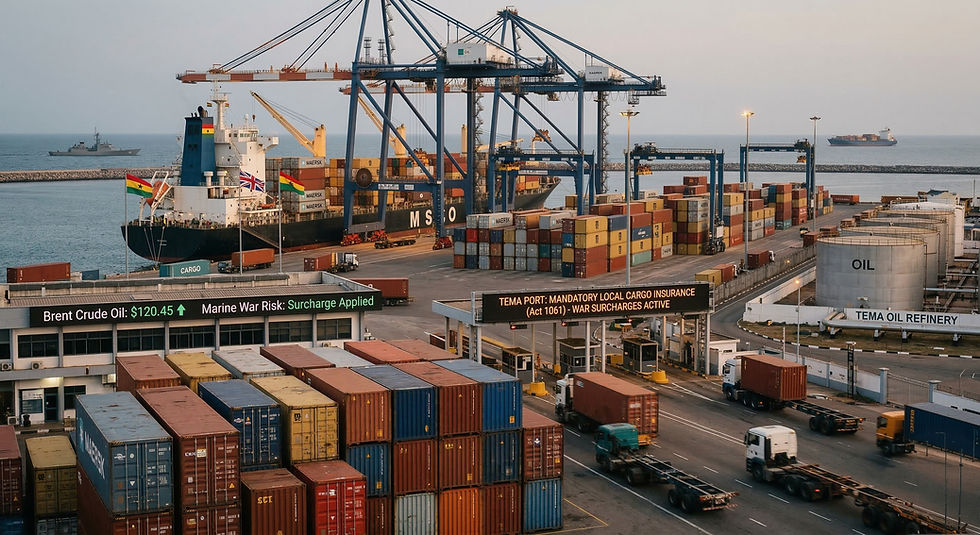
The rapid escalation of conflict in the Middle East over the past few days has moved beyond geopolitical headlines to become a tangible threat to global supply chains. For the Ghanaian insurance industry, this is not merely an offshore crisis; it is a systemic shock that will test the resilience of local portfolios, underwriting discipline, and solvency frameworks. As we move into mid-March 2026, the primary task for insurance executives and strategists in Accra is to move past the immediate noise and assess the long-term structural shifts that may hit our balance sheets. We must adopt a predictive stance, identifying the specific transmission channels through which this regional war could disrupt the Ghanaian domestic market.
The Marine Cargo Portfolio and the Challenge of Local Enforcement
The conflict arrives at a critical juncture for the Ghanaian marine sector. With the enforcement of Section 222 of the Insurance Act 2021 (Act 1061) now mandatory, all commercial imports into Ghana must be insured by local underwriters. This shift means the Ghanaian market is now the primary bearer of transit risks for goods involving the Red Sea and the Strait of Hormuz. We may see a significant surge in the demand for War Risk extensions for cargo. While these were historically viewed as ancillary covers, they are likely to become a central requirement for any shipment originating from or transiting near the conflict zone.
The industry must prepare for a scenario where cargo War Risk premiums jump significantly if the blockade persists. For the Ghanaian underwriter, the risk is not direct damage to hulls, as our local fleet is largely restricted to domestic waters, but the liability associated with delayed, diverted, or "trapped" cargo. If vessels reroute around the Cape of Good Hope, the increased transit time could lead to complex claims regarding contract frustration or the deterioration of perishable goods. Underwriters must review policy wordings to ensure that "Delay" and "Loss of Market" exclusions are robustly defined before these exposures materialize on our shores. While the direct hull risk remains minimal for local insurers, the spike in global hull premiums will hit us indirectly as "War Risk Surcharges" are passed onto our cargo clients.
Reinsurance Capacity and the Risk of Treaty Hardening
Ghana remains fundamentally a "follower" market, reliant on the capacity and pricing of global reinsurers. While the January 2026 renewal season was relatively stable, the potential for multi-billion dollar losses in the Middle East - spanning maritime, energy, and aviation specialty lines - could trigger a mid-year market hardening. We should be cautious in our projections for the July renewals. It is entirely possible that global reinsurers, facing a sudden depletion of capital, will look to recoup losses by raising rates across all regions, regardless of local loss history.
Specifically, Ghanaian insurers may find that reinsurers demand significantly higher retentions. If a local company is forced to keep a larger portion of a high-value risk on its own books because treaty capacity has shrunk or become too expensive, its solvency margin will be immediately pressured. This poses a strategic risk under the National Insurance Commission’s (NIC) Risk-Based Capital (RBC) framework. Executives must begin simulating "worst-case" reinsurance scenarios now, ensuring that their capital stacks are sufficient to absorb a higher level of retained risk should the global market pull back its support.
Energy Portfolios and the Imminent Under-Insurance Trap
The spike in Brent crude prices, now pushing toward $120 per barrel, creates an immediate valuation crisis for the Ghanaian energy sector. For insurers covering Bulk Oil Distributors (BDCs) and downstream infrastructure, the "Sum Insured" on existing policies may already be obsolete. If a loss were to occur today at a local tank farm or during a fuel discharge at the port, the cost to replace that product would be significantly higher than the value declared at the start of the year.
This creates a dangerous "under-insurance" trap. Under the Principle of Average, any claim payout would be proportionally reduced, leaving the client with a massive financial gap and potentially damaging the reputation of the insurer. The strategic response must be proactive. Underwriters should immediately engage their energy and corporate clients to conduct mid-term asset revaluations. In a market where the Cedi is already sensitive to global shocks, failing to adjust insured values to reflect the new reality of energy prices is an invitation to a solvency crisis during the claims settlement phase.
Motor Portfolios and the "Claims Inflation" Ripple
Motor insurance is the largest retail portfolio in Ghana, yet its profitability is often thin. The Middle East conflict will likely exacerbate this through "claims inflation." As shipping lanes are disrupted and freight costs for spare parts rise, the cost of vehicle repairs in Ghana will inevitably follow. Most motor policies in our market are priced on a fixed-tariff or annual competitive basis. If the cost of a replacement bumper or engine part for a popular model increases by 30% due to global logistics surcharges, the insurer’s loss ratio will deteriorate.
We must anticipate a period where we are settling 2026 claims with premiums that were calculated based on 2025 repair costs. Unlike marine or energy lines, where premiums can sometimes be adjusted mid-term, motor insurance is rigid. This means that the industry must find efficiencies elsewhere, perhaps through more stringent repair-shop vetting or digital claims processing, to offset the rising cost of parts. Strategically, insurers should also be looking at the long-term adequacy of their motor premium rates in light of this new, higher-inflation environment.
The U.S. Sovereign Backstop and the DFC Factor
A significant development in the past 72 hours is the announcement from the U.S. Government that the International Development Finance Corporation (DFC) will provide a sovereign backstop for maritime war risks. The U.S. appears ready to mobilize up to $20 billion in reinsurance capacity, with Chubb acting as the lead underwriter, to keep trade moving through the Strait of Hormuz. For the Ghanaian market, this is a potential lifeline that warrants close study.
Essentially, this move by the U.S. is an attempt to cap the spiraling cost of war-risk insurance by providing a government-subsidized alternative to the private market. If this facility becomes operational, it could prevent a total freeze in the shipment of essential commodities and fuel to markets like Ghana. However, we must be clear on the mechanics. These covers are likely to come with "strings," such as mandatory compliance with U.S. Navy-protected corridors. Ghanaian brokers and insurers should investigate how they can leverage these international backstops to offer more competitive and secure "wrap-around" covers for local importers, ensuring that the Ghanaian market remains a viable destination for global trade despite the regional volatility.
The coming months will demand a level of strategic foresight that goes beyond traditional underwriting. The Middle East conflict is currently a regional event, but its ability to disrupt the capital, capacity, and cost structures of the Ghanaian insurance market is absolute. Our success in 2026 will depend on how quickly we move from observing the crisis to pricing it.
PG Sebastian
Ghana Insurance Hub
Comments